

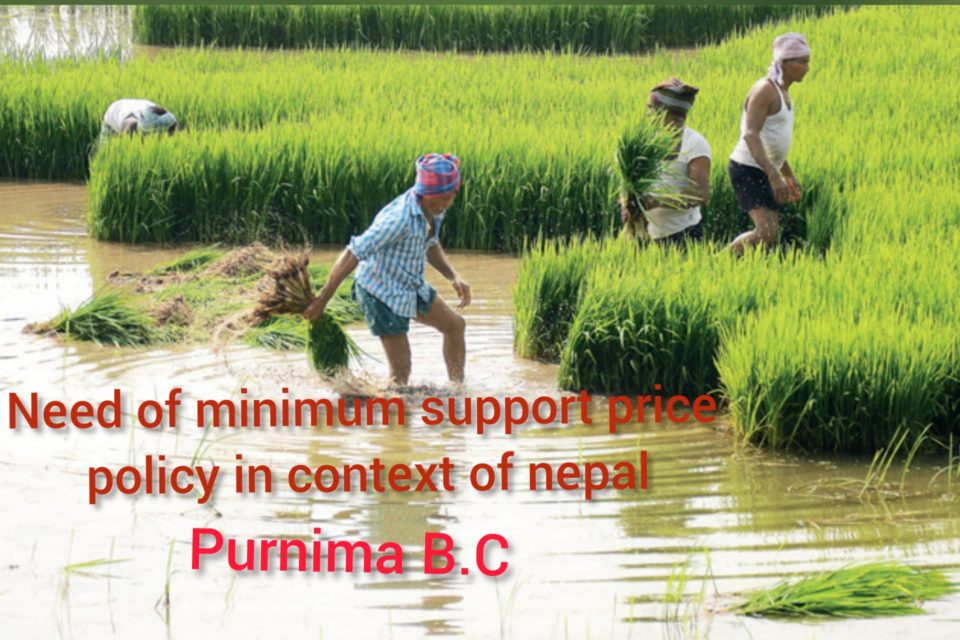
Purnima B.C-
The price of agricultural commodity is unstable, due to their variation in the supply, lack of market integration, and information asymmetry. A very good harvest in any year results in a sharp fall in the price of the commodity during that year which in turn harms the future supply as farmers withdraws from sowing that crop in the next/ following years. This then causes a lack of supply next year and the subsequent major price increases for consumers.
Middlemen take the advantage of a sharp fall in the price of a commodity. They buy the commodity at a low price from the farmer and sell them at a high price in the market where consumers have to buy those commodities at a high price. Here, middlemen are the only one who is getting profit farmers are not getting a reasonable price for their produce despite many obstacles like high production cost and unavailability of various inputs during production which leads to a farmer in the loss. It is one of the major problems in Nepal agriculture. To address this problem, the Minimum Support Price(MSP) plays a great role.
Minimum Support Price(MSP) is the price at which the government purchases crops from the farmers, whatever may be the price of the crop. It is a measure taken by the government to protect farmers against sudden slumps in the market price.
It is a tool which guarantees the farmers before the sowing season, that a fair amount of price is fixed for their upcoming crop to encourage higher investment and production of agricultural commodities. It motivated farmers to grow targeted crops and increase production. It also incentivizes the production of specific food crops which is short in supply. Its mechanism is beneficial in transferring incomes in rural areas and to counter farm level inflation. It countered the agricultural distress brought on by natural hazards in the country.
It provides higher profit for the farmer which helps them to invest in necessary infrastructure and equipment. It provides security to the farmers from the risk of crop failure and less production. It enhances the purchasing capacity of the farmers and acts as a tool to achieve food security. Realizing the necessity of Minimum Support Price, our government of Nepal had also adopted the Minimum Support Price(MSP) Policy. Here, we can take an example of paddys Minimum Support Price. The government had started setting the Minimum Support Price for paddy in 2016 after suspending the practice for nearly 2 decades following complaints from farmers that they were being deprived of a reasonable price for their produce. The Ministry of Industry, Commerce and Supplies had tabled the Minimum Support Price of paddy under the recommendation of the Ministry of Agriculture and Livestock Development. The government introduced a plan to fix the Minimum Support Price of crops before a plantation from this year aiming to ensure saving and profit for the farmers while planting the crops. The Minimum Support Price for coarse paddy has been fixed at Rs. 2,735 per quintal. Similarly, the support price for medium quality paddy is fixed at Rs. 2,885 per quintal this year. Last year, the government had fixed the Minimum Support Price for coarse paddy at Rs. 2531.80 per quintal and Rs. 2673 per quintal for medium quality paddy. The Ministry of Agriculture and Livestock Development had recommended the Minimum Support Price for the paddy ensuring 10 percent transporting cost along with a 20 percent profit in the cost of production. It is the first time that the government has got support price of paddy before the completion of the plantation of the crop. ; The fixing of support price by the government before the plantation was positive for the farmers and would help them to decide which type of paddy based on the rate. The government should manage the system to purchase the paddy from the farmers itself and to develop infrastructure for storage. This system would encourage farmers in expanding paddy plantation areas and increase production as well after the guaranteed sale.
The MSP is a key policy of the government to determine the floor price of major agricultural commodities so that the farmers are protected from middlemen and the fluctuating market condition, However, there are several problems while implementing MSP policy like the low procurement of crops other than paddy, delay in the announcement of the MSP, lack of proper announcement about MSP among farmers, heavy transportation costs, lack of storage facilities. Along with this surplus procurement without sufficient storage will result in a huge piling of stocks in the warehouses. So, proper planning should be made while implementing this policy. MSP is applied for few crops only. So, MSP should be applied for other cereals and agricultural commodities in the upcoming days.
If MSP is managed properly, it can be used by the government as a powerful tool in stabilizing the economy and to make the country self-dependent in agriculture. The produce purchased by the government can also be sold by establishing a fair price shop where the price of these products is less than the market price which makes these crops available to the below poverty line people at a lower price.
Purnima B.C Institute of Agriculture and Animal Science,Paklihawa
Bsc.agriculture
4th semester
